
CEOs of AI companies have called on Congress to “pace the frontier” of the most advanced model development. AI experts now are considered optimistic if their P(doom) — the probability that AI will end humanity — is “only” 10%; regulating AI to bring this probability down to near zero indeed seems quite prudent.
Climate change is in many ways a slower-moving analog to AI safety. Climate scientists don’t talk in the language of P(doom), but instead in the language of consensus-based, multinational, peer-reviewed IPCC reports. They don’t say explicitly that climate change will end humanity with any certain probability, but they are clear that the risks are real, even if small, that the consequences of climate change on water, food, migration, disease, and beyond could prove civilizationally challenging in the not too distant future.
What’s also clear from the IPCC reports is that carbon removal is civilization’s social security policy. It is unreasonable to expect that large-scale removal will be possible for decades into the future; just like we don’t get to collect social security until we retire. And carbon removal only meaningfully addresses the civilizationally-challenging tail risks of climate change if we also decarbonize our economy entirely in parallel; just like we wouldn’t have any social security to draw from in retirement if people weren’t working for decades prior.
But if we don’t have carbon removal at scale in the future, we risk economic collapse, global health crises, and military conflicts with far higher probability that we otherwise would with a stable climate “well below 2oC” as agreed in the Paris Agreement. An unhappy retirement, at best.
And we are not on track to have carbon removal at scale in the future. The State of CDR report’s headline is that we have 2Gt of removals annually today, and need something like 2-10x that quantity by midcentury.
That scale up seems manageable, but is misleading. Of that 2Gt of removals today, 99.95% comes from more or less accidental carbon removal via replanting of forests. This amount of forest carbon removal is also dwarfed by the amount of carbon emissions from deforestation. As the climate warms, populations grow and get richer, the headwinds to scaling removals via the land sector get more and more challenging. We should try to get as much forest carbon as we can; but we also need to plan that as much as we can get is far from what we will ultimately need. In other words, when it comes to land sector carbon removal: hope work as hard as possible for the best, but plan for the worst.
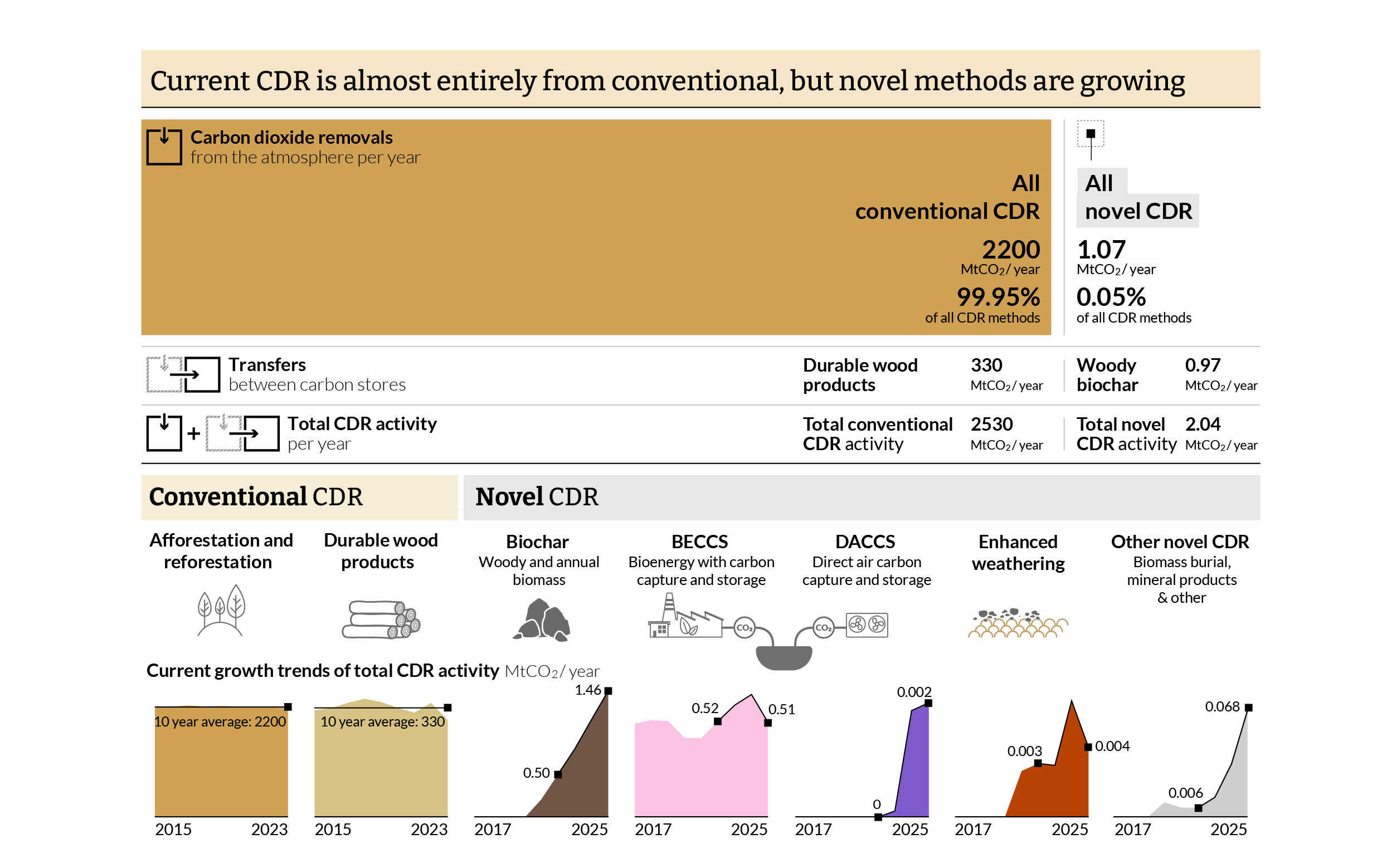
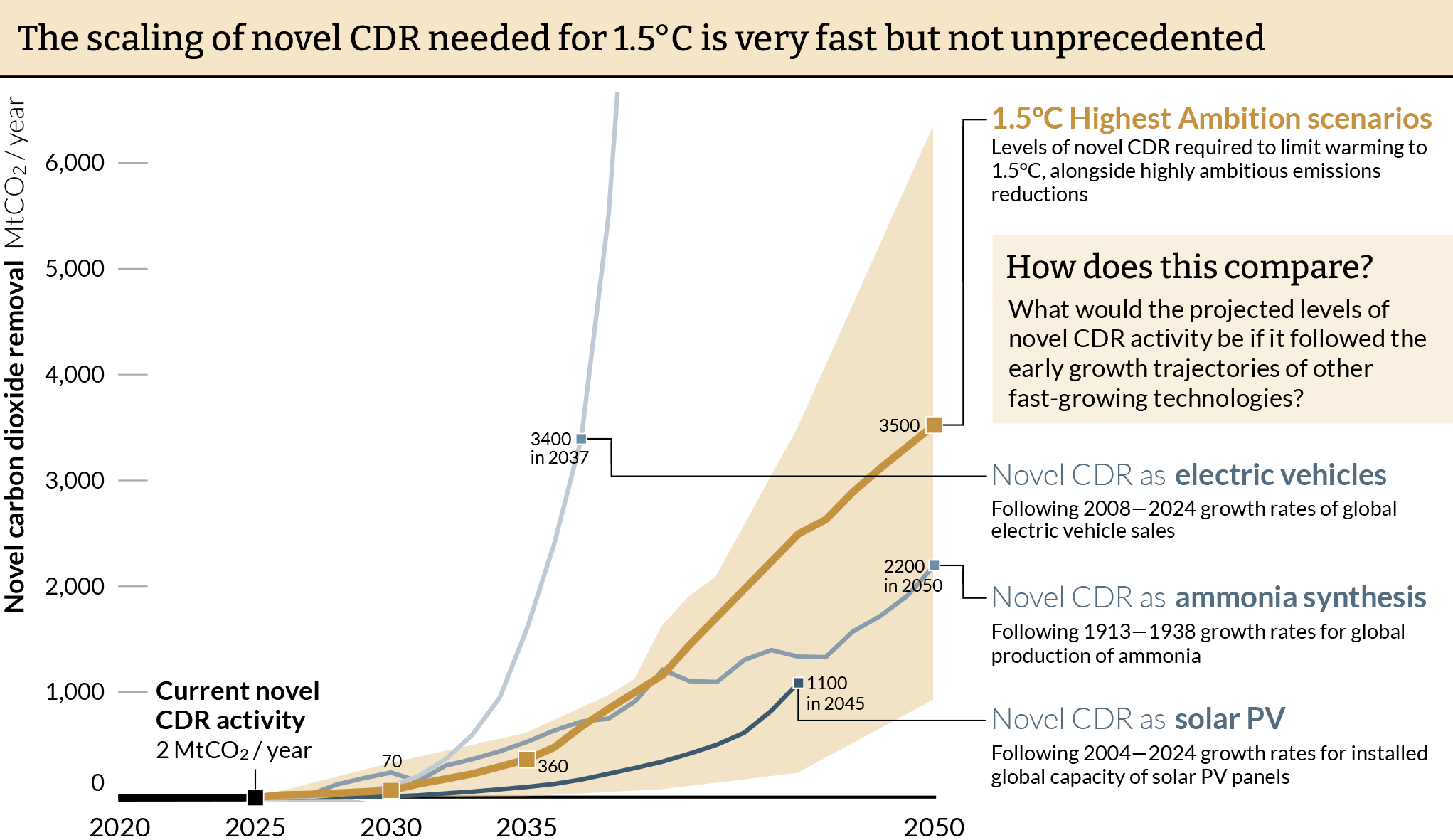
As a result, we need to plan for developing on the order of 2-10Gts of “novel” carbon removal annually within a few decades. And if you look at the State of CDR report’s estimates for that slice of the carbon removal puzzle, we need to scale novel removal approaches 1,000x from their current levels today. This challenge is slightly more daunting challenge than the headline figure for overall removal would imply…
Scaling such novel removals three orders of magnitude in a few decades isn’t historically unprecedented for analogous technologies. The State of CDR report shows that other clean technologies like EVs and solar PV — and even for some decidedly unclean technologies like ammonia synthesis — have scaled as fast as novel removals need to over the coming decades.
But scaling carbon removal this much this quickly will require $Ts in capital. Even at breakneck speed, it will take decades of innovation and construction to build the physical machinery involved in moving CO2 out of the atmosphere the scale needed. This scale happens to be larger than any industry today by volume. So think of the removals industry of the future as the global cement, oil, wheat, etc. industry today, just bigger.
The necessary capital for scaling removals won’t get deployed without some sort of policy framework that incentivizes and/or mandates companies to build carbon removal at successively larger scales. And those policy frameworks are not in place, anywhere in the world. Pieces of these policy frameworks exist in the U.S., Canada, and Europe. But they are far from sufficient for driving the scale up of removal.

Source: https://policy-dashboard.climaterecoveryinstitute.org
Historically, the climate community has pushed back against comprehensive policy frameworks for commercializing carbon removal in favor of smaller innovation funding programs for the field out of worries that we would scale up removals too fast. Scaling removals too fast could indeed have negative unintended consequences for the communities, workers, and environment where projects are deployed. It could also divert resources (and/or attention) away from the scale up of clean energy that is also moving slower than it could be.
But the good news is that carbon removal is the tortoise to the AI safety hare. “Pacing” the frontier means we move with the speed needed to scale removal, but not so fast that we run into negative unintended consequences.
Right now, removals are dramatically on the “too slow” end of the spectrum, not the “too fast” side. So we need to pick up the pace, but make sure that as we do, that we have the safeguards needed to ensure the pace is appropriate, not too fast.
Pacing the frontier for removals would be relatively straightforward for policymakers today, and involve a few steps like:
Funding ambitious innovation programs at the $Bs/year (effectively 10x where we are today) in public subsidies with technology stage gates at successively larger scales to make sure technology works as planned (and when it doesn’t work as planned, stop and/or fix the problems).
Creating standards for carbon accounting, environmental, and social protection that ensure projects are built in the best way possible.
Boosting demand for removals from the Mt/year level today to the 10Mts/year level ASAP, growing to 100Mts/year within a decade, either via polluter-pays obligations like European emissions trading systems and/or via government subsidies like U.S. and Canadian-style carbon removal credit public procurement programs.
In parallel, if we tax and regulate removals project development appropriately to support communities, we can build a virtuous cycle where the frontier is moving with enough pace for climate, but not too much pace that it hurts people or the environment inadvertently.
Where this all comes back to “pacing the frontier” for AI is that we have yet to see any CEOs of any major companies call on the government to support carbon removal in the same way that they have called on governments to embrace AI safety regulations. It is great that AI giants like Anthropic and Google are members of the Frontier carbon removal advance market purchase program. But buying voluntary carbon credits is going to provide nowhere near the pace that the frontier of carbon removal needs.
For that pace, we have to call on governments to pass policies to incentivize removals. And there is no one anywhere near the stature of technology company CEOs calling for appropriately paced removals development today. If there was this level of advocacy, it could have enormous influence in helping build support for removals in the U.S. and beyond, as policymakers that want to support removals are looking for signs from their constituents that doing so will be rewarded today.
Advocacy for removals from technology companies doesn’t need to be front-page NYTimes news to be effective either. Carbon removal is an essential component of climate policy today. But carbon removal is not a headline priority for the climate advocacy community today. Those headline climate policies today are incentives and regulations to scale clean power, electrify everything, end deforestation, and cut methane and CO2 from oil and gas operations and use.
But just because carbon removal is not a headline priority doesn’t mean it can be ignored. Funding for removal on the order of $10B/year in both the U.S. and Europe would be a drop in the bucket for either geography, yet would be sufficient to advance removals with the appropriate pace, neither too fast nor too slow.
I understand that the median big tech company government affairs executive will tell their CEO that they need to focus their advocacy exclusively on core business tax and regulation policies, and not distract or complicate their efforts in these domains with advocacy for longer-term policy priorities like carbon removal. But because carbon removal is not at the forefront of climate policy and enjoys bipartisan support today, it has little risk of becoming a lightning rod for either party that distracts from their core policies. And because carbon removal advocacy is a little more altruistic than advocacy for lighter taxes and regulation on technology, it might even have a small but marginally beneficial boost to their overall standing with legislators, helping them with their core business priorities as well. In other words, carbon removal advocacy should be an easy ask for policymakers.
If the CEOs of big tech companies can summon the courage to speak out in favor of carbon removal policies, they can have an enormous impact on the pace of the carbon removal frontier — likely far more impact than they could by only purchasing carbon removal credits. And who knows, maybe they even tip the scales on climate in a way that lets our grandchildren have a habitable planet on which to enjoy their well-behaved robot butlers and flying cars (or whatever the future they are building with safe AI is promising…).