
Last week, the Stanford carbon storage initiative convened a group of academics, NGO practitioners, and industry representatives in Houston to talk about the current status of, and potential future for, enhanced oil recovery (EOR). When US oil and gas production looked like it was on a terminal decline pre-2005, EOR was a hot topic of conversation, given its potential to boost oil production from existing domestic wells. With the rise of the shale revolution, however, the need for EOR faded. So did conversations on the topic, with legacy EOR operations quietly continuing in the background, but little new development happening.
Back at the time when EOR conversations were more front and center in US energy discussions, the direct air capture (DAC) industry was only a twinkle in the eye of a few academics. Because the DAC industry has emerged entirely post-shale revolution, it comes as little surprise that most DAC companies have avoided business models tied explicitly to EOR. DAC companies have all been motivated by climate, and explaining how using DAC to make more oil and gas could be a win for climate wasn’t worth the communications effort.
The Stanford-hosted workshop didn’t convince me that EOR was imminently going to be on the rise as a more meaningful piece of the broader US energy security and climate conversation. But it did make me think that now is the perfect time for DAC companies to develop a more nuanced approach to EOR — and that DAC developers, credit purchasers, and policymakers alike should stop a priori exclusion of EOR as a path to market for DAC that can deliver meaningful climate mitigation.
But first, some background.
EOR is a process where drillers pump CO2 into depleted oil wells to produce more oil. CO2 acts like a fluid that “unsticks” oil that remains trapped to the surrounding rock. Over time, effectively all of the injected CO2 becomes permanently geologically stored in the oil reservoir.
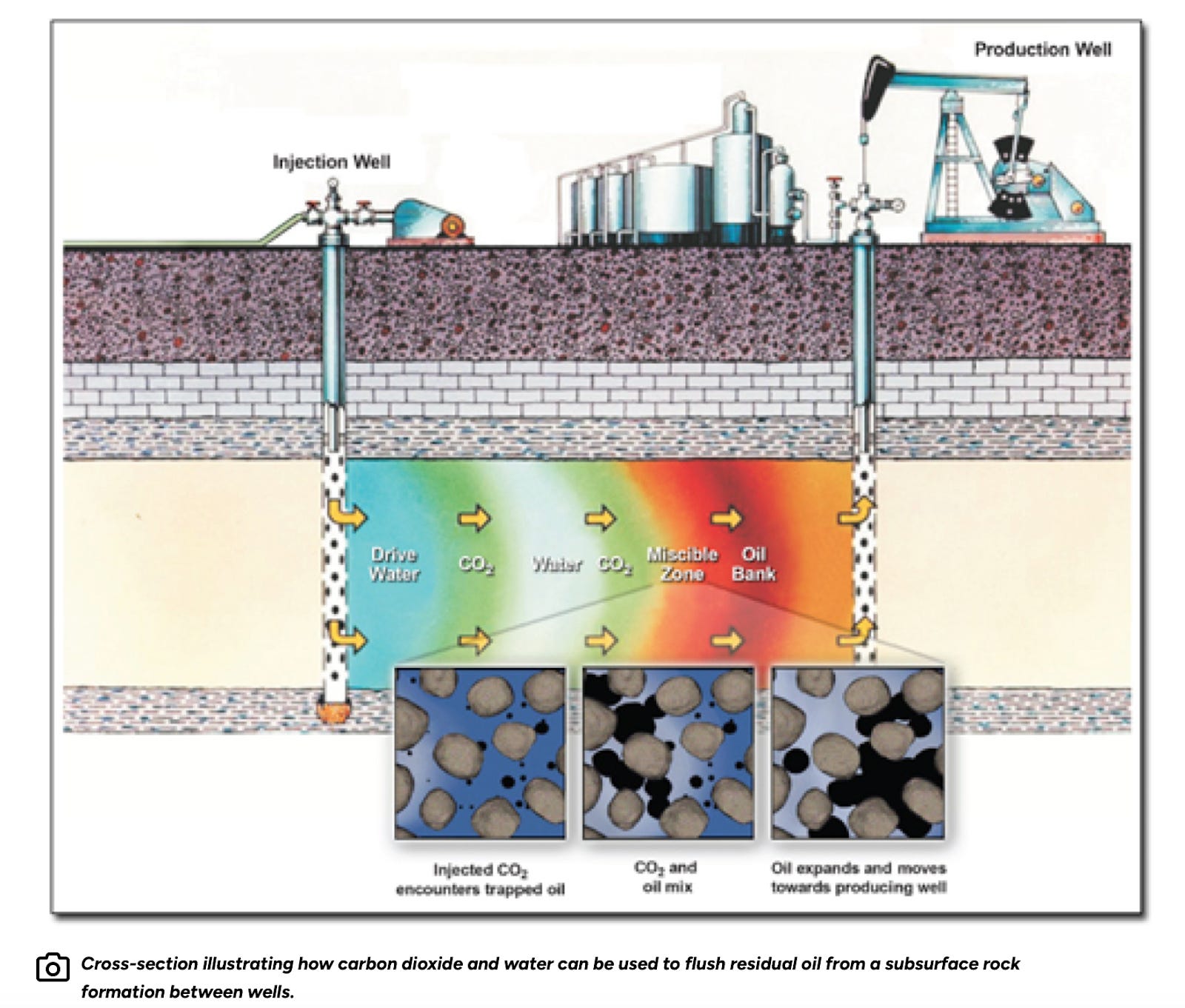
Source: DOE
The CO2 used for EOR can come from anywhere: the air all around us, deep underground reservoirs, a power plant’s smokestack, etc. Historically, US EOR operators have looked down to find CO2. We have drilled around 2 billion tons of CO2 from a handful of underground geologic formations (that is, natural reservoirs that have trapped CO2 in rocks deep underground for millions of years) for use in EOR. More recently, EOR operators have looked to industrial facilities to source their CO2. There is now a coal power plant, a hydrogen production plant, a natural gas processing facility, and several bioethanol refineries that have been equipped with CO2 capture technology to supply EOR operations across the US.
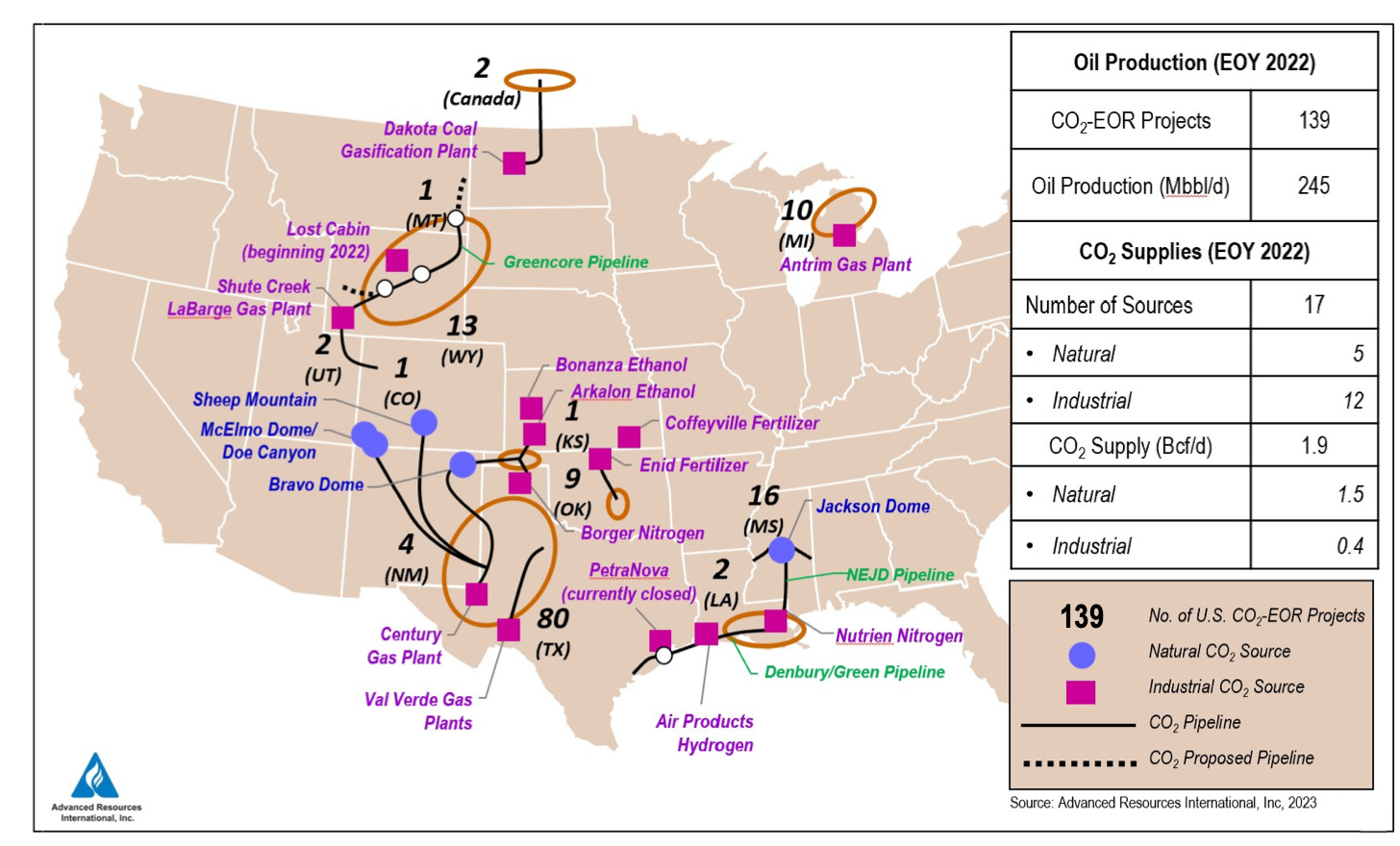
Source: ARI
DAC developers, however, have yet to explicitly try and sell EOR operators on looking to the air as a source for CO2. Instead, DAC developers have opted to pursue business models for dedicated geologic storage and/or non-EOR CO2 utilization like CO2-infused concrete.
This lack of interest from DAC developers in EOR is due in part to business realities. Until last year, US tax credits (specifically the 45Q production tax credit) had provided over 25% more value for dedicated geologic storage compared to use in EOR operations.
Even now that OBBBA amended the 45Q tax credit to provide parity for EOR and geologic storage, there is still a sizable gap between the revenues available for EOR and the costs of DAC. The price of geologically-extracted CO2 sold to EOR operations is linked to oil prices, and has historically fetched around ~$30/ton when oil is ~$70/barrel. Even if DAC can come down the cost curve to $300/ton in the near term, this means that a voluntary carbon credit of ~$100/ton would be needed to make oil produced from DAC EOR profitable (in addition to $180/t from 45q + ~$30/ton from the EOR operator).
But a major reason why DAC developers have shied away from EOR is perception. If the purpose of DAC is to help us reverse emissions from oil and gas combustion in the long run, tying its near-term commercialization to the production of more oil and gas production from old oil wells seems counterproductive. This concern appears particularly well warranted, given that the US is blessed with ample capacity for geologic storage of CO2 in similar reservoirs with no associated oil and gas production. And, given the oil and gas industry’s track record of unabated emissions and misinformation about climate change, claims that more oil and gas production can contribute to climate mitigation is met with healthy skepticism, if not full blown cynicism.
But that seemingly intuitive thesis is worth reexamining today for a number of reasons.
First, EOR produced with DAC-derived CO2 (or “DAC EOR”) is unlikely to have a meaningful impact on oil markets one way or another in the near term. In recent years, EOR made up roughly 2-5% of US oil and gas production, consuming roughly 50Mt/year of CO2 mined from deep underground geologic domes. Even if DAC scaled at a heroic pace to replace all this CO2 (i.e. roughly 100 “Stratos-sized” DAC projects), it barely would make a dent on the 13Mb/day of US oil and gas production. Given that the US is highly unlikely to cut oil and gas by >95% in the next decade or two, DAC EOR is unlikely to have any meaningful influence on US oil production.
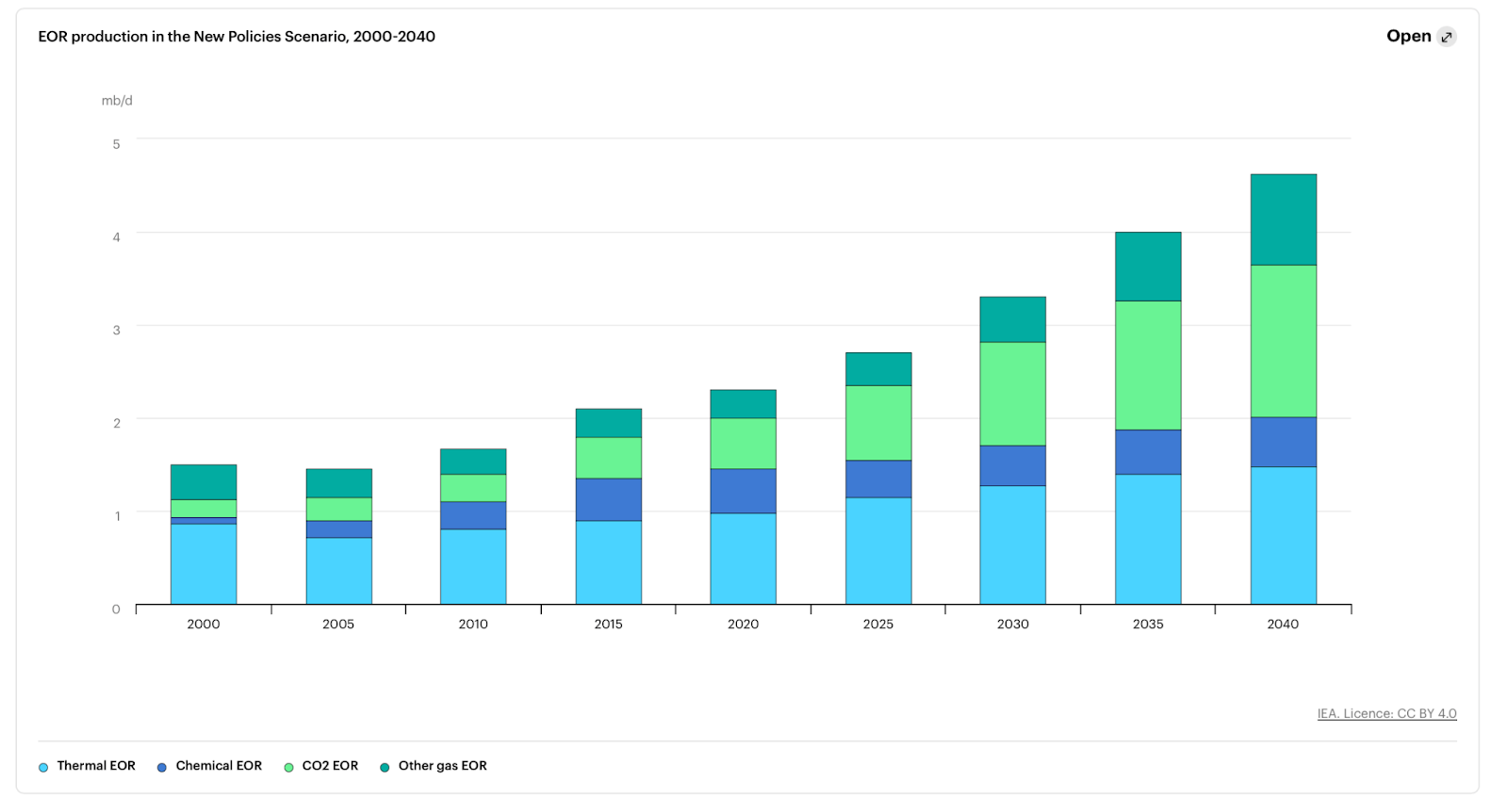
Source: IEA
The real reason that DAC EOR is unlikely to have a meaningful dent on US oil production in the near term is not DAC, but EOR. EOR is a hard business, especially compared to fracking. Comparatively, EOR is more capital intensive, requires longer payback periods, and involves more specialized drilling expertise. In an environment of strong capital discipline today, oil producers are unlikely to want to scale up EOR operations in a meaningful way at the expense of other fracking opportunities. Sure, there are likely to be a handful of cases where DAC EOR makes sense, but there is nothing about the techno-economics of EOR that suggest it will be a dominant force in US oil and gas production anytime soon. Yes, this calculus could change in an environment where US oil production starts declining rapidly (due to us running out of supplies), but few think that we will be in that world anytime soon.
But even if DAC did make a dent on oil production, its impact would counterintuitively be beneficial for emissions reductions efforts. The reason is that DAC EOR wouldn’t add much if any oil to global markets. Instead, by adding DAC EOR to the supply of fossil fuels coming from the US, other barrels of production would not be produced. The barrels of oil that get substituted by DAC EOR would be more carbon intensive: DAC EOR can have a very low, and even net-negative, carbon intensity with the right supporting policy. Other oil production on the margin of productivity today that would likely be displaced by DAC EOR comes from places like Venezuela, Central Asia, and Russia, which produce significant emissions in the extraction, transportation, and refining processes (and benefit geopolitically from the oil and gas revenues vis a vis the US and our allies).
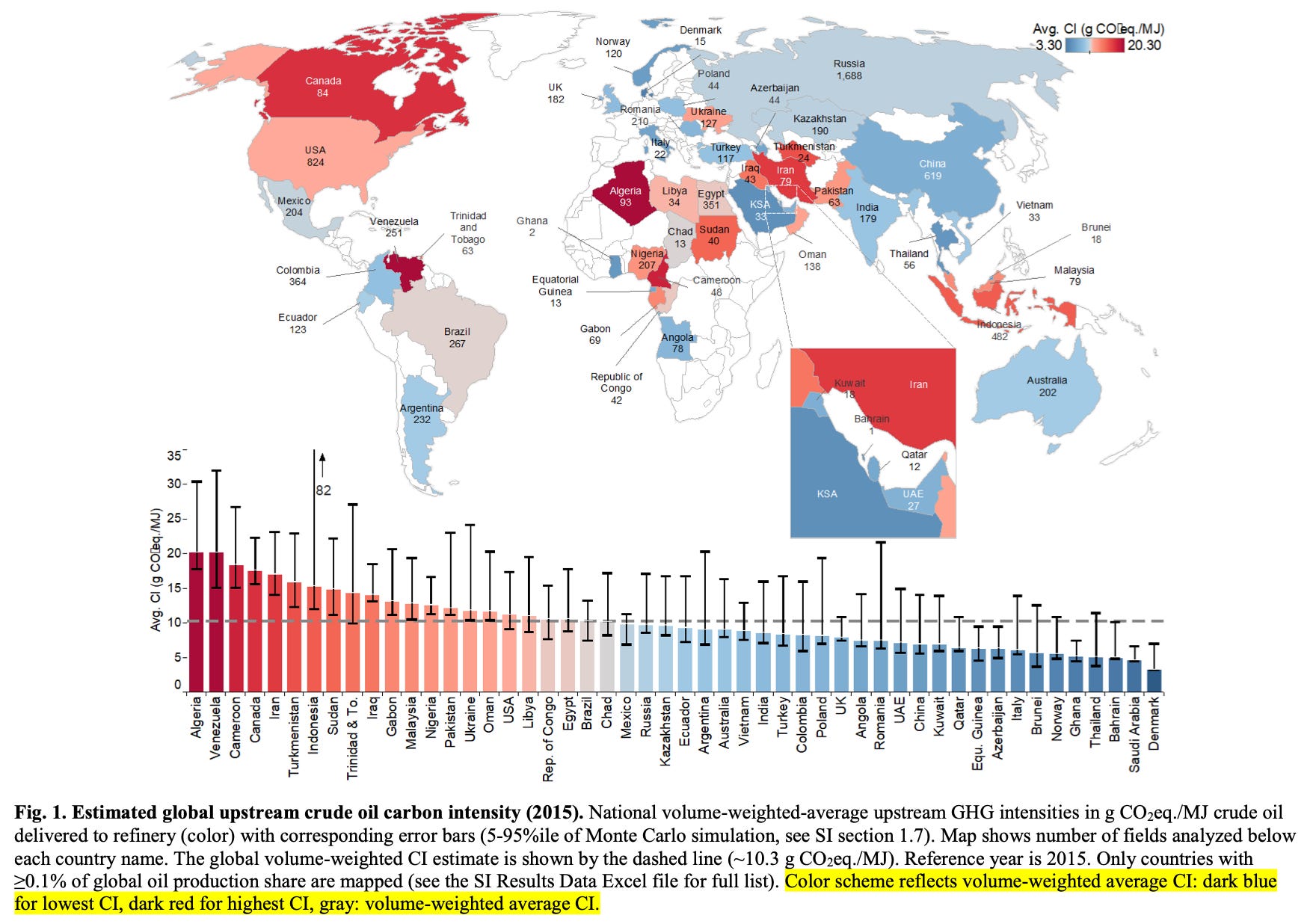
Source: Stanford
Beyond climate, DAC EOR can be designed to deliver additional environmental and economic benefits. For one, because EOR is inherently “brownfield,” it likely means that it would lead to less new “greenfield” oil drilling and the additional local air and water pollution (and biodiversity impacts, etc.) that such development can create. And because DAC EOR oil can have a low carbon intensity, it is well positioned to compete in future oil markets that incentivize the lowest carbon fuels (such as future iterations of the European Union’s Carbon Border Adjustment Mechanism). DAC EOR can offer oil and gas workers and local communities that depend on oil and gas revenue to provide public services today a longer runway and more stability as the world economy transitions to renewable energy.
And while early DAC EOR deployment is unlikely to have big impacts on energy markets or the environment, DAC EOR could have big impacts on DAC innovation. The reason is that DAC EOR also offers important political diversity that can help with the long-term sustainability of DAC policy in the US. While the Republican Congress gutted many clean energy tax credits in the IRA in the OBBBA, the DAC credit value for 45Q was preserved — and even increased for EOR use. EOR enables DAC to contribute to energy security and abundance in a way that is critical for garnering Republican support. This is a feature, not a bug: the bipartisan nature of the 45Q tax credit enables investors to finance DAC over the decades it takes to pay off the project’s costs, where swings in political power are nearly guaranteed.
DAC EOR also can act as an affordability strategy in high ambition climate policy efforts. For example, the aviation industry might find that DAC EOR is the most cost-effective and sustainable way to fly zero-carbon long-haul flights (given that biofuel production has struggled with high costs and environmental impacts for decades). If ambitious climate policies become too expensive or restrictive, political pressure will grow to weaken these efforts in ways that DAC EOR might be able to mitigate.
This confluence of potential benefits from EOR could enable policy support from unlikely places (i.e. the current US Administration). It could also enable voluntary corporate support that unlocks early projects. These projects could provide essential technical and financial derisking, and enable the field to scale more effectively in the future, leaning primarily on dedicated storage as the market and politics evolve.
So what can corporate sustainability leaders and policymakers do when it comes to DAC EOR? First, treat EOR in a more technology-neutral manner when it comes to incentivizing DAC. That is, don’t artificially favor it vis a vis dedicated geologic storage; but also don’t oppose it on principle. Acceptance of a broader suite of CO2 storage and market opportunities will enable broader consensus for DAC innovation policies across political lines without forcing the market towards any particular storage pathway suboptimally.
Second, conditional on industry’s interest in DAC EOR projects, leaders should encourage purchases from projects that can demonstrate the lowest overall carbon intensity, with the greatest local benefits and strongest risk mitigation efforts. Not every EOR project delivers strong benefits or mitigates environmental risks appropriately, but many do; investing in the diligence needed to support EOR operations that provide the greatest net-benefits and offer the most comprehensive risk mitigation efforts is critical.
Third, leaders should ensure that EOR is not the only pathway that we develop today, and that EOR incentives phase out over time. Experts are clear that we should avoid pursuing EOR as a replacement for a de-fossilized future, so leaders should be thoughtful now about how to leverage EOR in the near-term as a tailwind for innovation without EOR growing into a headwind for overall climate mitigation efforts. Given EOR economics, this means simply continuing to pay a small premium for dedicated geologic storage — bans on EOR are likely unnecessary in addition to making dedicated geologic storage the long term solution of choice for DAC developers.
Fourth, stakeholders should push for a capable and fair environmental, health, and safety regulatory apparatus for all types of DAC. Strong protections for the environment, workers, and communities that host DAC projects that are clear and workable for industry are an essential foundation for DAC to succeed regardless of the storage mechanism. Most of the conditional claims up I’ve made up to this point about DAC EOR being a good strategy are premised on a capable and fair underlying regulatory regime for carbon accounting and ensuring leak-free, safe, and clean operations.
The net effect of these actions will be a stronger, more resilient foundation for DAC to commercialize in the near-term. It will also help avoid competition for decarbonization in the long-run, delivering a small but significant contribution to climate mitigation and local economic and environmental benefits along the way. Yes, this story of tying climate solutions to oil production is counterintuitive, but with thoughtful and nuanced execution it can be a reality.