
I have enormous respect for Project Drawdown. In the early days of the Carbon180 (known as the Center for Carbon Removal at the time), Project Drawdown co-founders Amanda and Paul were invaluable fellow travelers and thought partners in thinking through what role carbon removal could and should play in our broader climate efforts.
From its inception, Project Drawdown was clear that carbon removal was a necessary but ultimately small lever in our efforts to reach net-zero, then net-negative emissions globally. I recall that the original book featured a handful of mostly nature-based carbon removal approaches in its list of 50+ solutions for decarbonization. DAC was mentioned with cautious optimism in the “emerging approaches” section. Basically, Project Drawdown got their story on CDR roughly right a decade ago.
The good news is that everyone else in the climate community is now largely caught up. The UNEP’s overshoot report and the IPCC’s latest Assessment Report makes it clear we need CDR to meet the Paris Agreement goals, and that we also have to overcome major technical, economic, and social challenges to scale CDR up responsibly. NRDC just joined WRI, EDF, CATF, and RMI as part of the cadre of large environmental groups to make it clear that we should be working on “CDR done right” today. Environmental leaders with unimpeachable climate credentials — Christiana Figueres; Senators Sheldon Whitehouse, and Brian Schatz; former DOE Secretary Jennifer Granholm; venture capitalist / uber philanthropist John Doerr — have all voiced active support for responsible carbon removal development.
Everyone else, that is, save for Project Drawdown. Project Drawdown’s primary message today on CDR is that large-scale deployment is a fantasy. Sure, we need it on a small scale. Sure, some smaller-scale things — i.e. protecting and restoring natural carbon sinks, biochar, etc. — are promising. But banking on 10+ gigatonne/year-scale CDR is dangerous. The reason is it dangerous is that nature-based solutions have limited potential, and CCS-adjacent technologies like DAC and bioenergy with CCS are unproven (and thus unlikely to scale to significant levels cost-effectively anytime soon, if at all).
So is Project Drawdown of 2026 the Cassandra warning against reliance on large scale CDR, in the same way that Project Drawdown of 2016 was the Cassandra warning against reliance on emissions avoidance alone? Should we avoid “wasting” money on technological CDR commercialization today, as is implied by their messaging?
Unfortunately not. Today, the Project Drawdown team is missing the mark in a few crucial and inexcusable ways when it comes to CDR. First and foremost, no policymakers are “banking” on large-scale carbon removal today. Banking on CDR would imply governments have large plans to deploy CDR in the 2050+ timeframe to clean up residual fossil fuel emissions that persist because we haven’t decarbonized as fast as we otherwise could have. To my knowledge, no government anywhere in the world has made this claim. In fact, the vast majority of governments are doing the opposite: completely ignoring CDR. The only reasonable read of our collective climate pledges is that governments around the world are banking on missing the Paris Agreement targets. Only a few governments have explicit CDR strategies (e.g. UK, EU, California, the US under Biden), and all of these geographies estimate that CDR will be needed to offset ~5-10% of their overall emissions required to get to net-zero by midcentury — far from gargantuan numbers. Today. CDR is uncommon in Nationally Determined Contributions to the Paris Agreement as the State of CDR report makes clear.
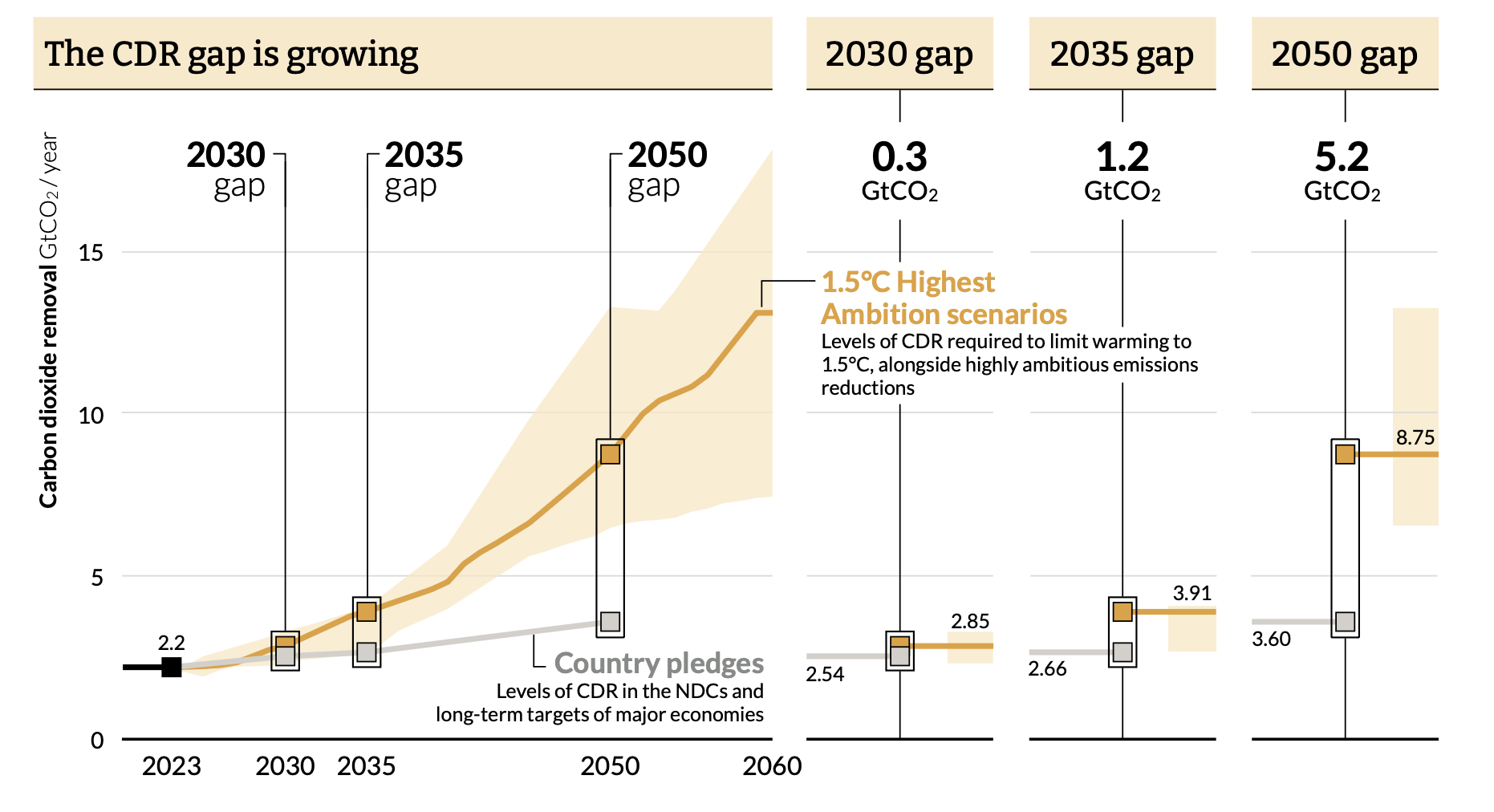
I haven’t even seen implicit banking on large-scale CDR. Anecdotally, I have talked with many government climate policymakers from around the world about the role they want CDR to play in their national climate strategies, and not once has anyone implied that they don’t actually have to decarbonize that fast today, so they can just do mega-scale removals in the future.
So where does this claim that we are banking on super-sized CDR come from? From integrated assessment models, a.k.a climate scenario models. These models are economic optimization tools that show least-cost pathways to decarbonize the global economy, given various technical and macroeconomic assumptions. Some of these models have a whopping amount of carbon removal in them: 10Gts/year by the end of the century to meet our Paris Agreement goals.
The point of these models isn’t to “project” that this much CDR will happen. It is to show that it would be economically optimal to have that much CDR if we want to meet our climate goals using a set of reasonable but definitely wrong assumptions. The assumptions underlying these scenario models are definitely wrong because technology and macroeconomic conditions are unknowable in 2035, let alone in 2050 and beyond. People who build economic scenario models make these caveats all the time, and organizations with such deep climate science expertise like Project Drawdown know this. By intentionally misrepresenting what scenario models are saying, Project Drawdown is trying to make a case that technological CDR isn’t needed, wrapped in a patina of climate math.
The truth is that no one has any clue what amount of CDR we will need. We could decide that adapting to the ~3C of warming that we are currently on track to hit — or the 0C of warming that we could theoretically achieve through indefinite solar geoengineering — is fine, and we need no CDR at all. Or we could end up in a world where we want to avoid overshoot through aggressive deployment of reductions and removals at multi-gigatonne/year scale. In this latter future, having the option for a wide range of CDR approaches at scale will be extremely valuable, especially as it becomes harder and harder to preserve and restore natural carbon sinks as the planet warms.
The second big issue I have with the current Project Drawdown framing is their confidence that certain CDR pathways like DAC and bioenergy with CCS are doomed to failure. Take solar PV as an analog. It was easy to say solar PV was never going to work in the 1980s, when it cost $100/W. Exxon shut down its wholly-owned Solar Power Corp. using this exact logic. Fast forward 40 years, and the solar PV skeptics were wrong. At the same time, the solar skeptics were right about other things: thin film and solar thermal never panned out like many early supporters had hoped.
What solar points to is the need for humility in making technoeconomic prognostications decades into the future. In the same way that economic models can’t project the future needs for CDR, a climate NGO can’t project which CDR solutions will actually scale — no matter how deep a bench of technical experts they have on staff. For every expert that thinks various CDR approaches probably won’t work, there is a bench of impeccably-credentialed academic experts saying the opposite could be true (e.g. National Academies land and marine CDR roadmaps, CDR Primer, LLNL Roads to Removals, etc.).
The reason that no one knows for sure what solutions will and won’t scale is that technology innovation isn’t some exogenous force that just happens to us. We have to decide whether we want it to happen, and we have to commit sustained resources to it. Successful technology innovation isn’t guaranteed if we invest in making it possible; but failure is guaranteed if we don’t try.
Project Drawdown’s messaging on tech CDR is effectively a call to give up on the whole tech CDR field to failure intentionally, without even trying to gather the evidence that any branch of the tech CDR tree could possibly work. This turn away from cautious optimism about CDR to incautious pessimism is deeply disappointing. The magic of Project Drawdown initially was its ability to make something that seemed to be impossible — net atmospheric CO2 drawdown within a few decades — look plausible with a reasonable read of the available academic evidence. There wasn’t a silver bullet to drawdown, but a silver portfolio of relatively small steps basically anyone could take, with all of the little things adding up to victory on stopping climate change. Now, we have even more evidence that CDR of all stripes can work as one of these little pieces of the portfolio, but that it will be extremely challenging to scale it responsibly. Using disingenuous interpretation of the academic literature on tech CDR to push for it being confined to the dustbin before it has a chance to do the early commercialization needed to assess its viability seems counter to the spirit of the Project Drawdown that I respect.
Furthermore, fighting against a full portfolio of CDR development and commercialization today seems completely unnecessary. Technological CDR is dramatically under-funded, not overfunded:
Less than $100M in philanthropic grant funding supports tech CDR NGO work today, around 1% of the $6B in total foundation giving to climate in 2024.
Government innovation funding for tech CDR globally is in the single digit $Bs cumulatively — compared to the $10Bs funded for clean energy innovation annually.
Corporate technological CDR purchases have flatlined in the low $Bs/year
Yes, we need more funding for nature-based removal solutions. But we also need significantly more money for technological CDR as well. If you made me be more specific about what I think the appropriate portfolio weight should be for technological CDR in the climate mitigation portfolio today. I would say about 5%. That is, we should plan to offset roughly 5% of our current emissions with tech CDR to get to net zero. Invest 5% of our climate tech innovation dollars, 5% of our climate philanthropy, and 5% of our climate finance in tech CDR. I would suggest roughly the same heuristic for nature-based solutions.
If forced to make zero-sum tradeoffs, I would suggest that we should taper down our support for commercially competitive renewables like solar and onshore wind today to cover this increased investment in CDR (to be clear, I don’t think we should be zero-sum and instead spend a lot more on climate tech innovation and commercialization overall). The idea that we should fight against tech CDR to find more support for nature-based CDR seems deeply counterproductive given that we should be fighting for both today.
Given this context, it is both perplexing and saddening to see Project Drawdown’s evolution on CDR. To an outside observer, it seems like an organization that was founded to make the concept of drawdown — not just emissions reductions — the norm, is now fighting against this foundational premise. The responsible message on CDR is no different today than it was a decade ago: removals are a small but significant piece of the net-zero — then net-negative — equation, and we still don’t know (1) how much removals we will actually need or (2) which removal solutions will be able to deliver this quantity of removal safely, reliably, and cost-effectively. I think the responsible conclusion from this message is that we should devote a small portion of our decarbonization portfolio to a big portfolio of removals commercialization. Otherwise, we risk unnecessarily hobbling the actual project of atmospheric GHG drawdown before potentially critical pieces of the solutions portfolio even leave the starting gate.
Noah I just wrote about the dangers of relying on integrated assessment models, and economic models in general, to predict the future. They create easy attacks for the fossil industry, or in the case of CDR, easy ways to claim a future success.
I agree with Drawdown's concern about this but wish they would recognize the origin of the problem: the fossil industry is using CDR to lie about climate outcomes. CDR is not the problem any more than recycling solar panels or lack of lithium or added costs of electric cars. They are all attack surfaces that fossil uses to delay action. I'm sorry that Drawdown has taken this approach when their efforts would be better spent attacking lies and discussing ways to solve problems.
https://rogeraines.substack.com/p/why-much-economic-thought-fails-the?r=9x4zs&utm_campaign=post-expanded-share&utm_medium=web
The distinction between scenario models and actual planning is a fair one. At the corporate level the picture is closer to your read: the SBTi Corporate Net-Zero Standard asks for deep value chain cuts first and reserves removals for neutralizing residual emissions. The open question is whether interim claims quietly lean on removals ahead of that. Do you see a reporting practice that would show buyers whether removal purchases sit on top of reductions or in place of them?