Dispatch from Carbon Removal Canada Day
Erin and I found better vibes on carbon removal last week when we journeyed north for Carbon Removal Canada's annual conference


Erin and I travelled up to Ottawa last week to participate in Carbon Removal Canada’s annual Carbon Removal day. The event showcased an increasingly vibrant (and growing: the 300+ people in attendance wouldn’t have fit in the room at the first Carbon Removal Day) carbon removal ecosystem in Canada, featuring collaboration across government, private sector, and civil society at the national, provincial, and community level.
Here are a few key things that we took away from the event:
1. Canada is thinking about gigaton(ne) scale.
Not all early movers on carbon removal are focused on getting to a billion tons/year and doing so within their own borders. Canada has the right geology, industry, and policy frameworks to consider what a realistic pathway to this goal looks like–check out Carbon Removal Canada’s report on exactly that–and how they can do so in ways that drive economic growth and build on their existing industries and climate goals.
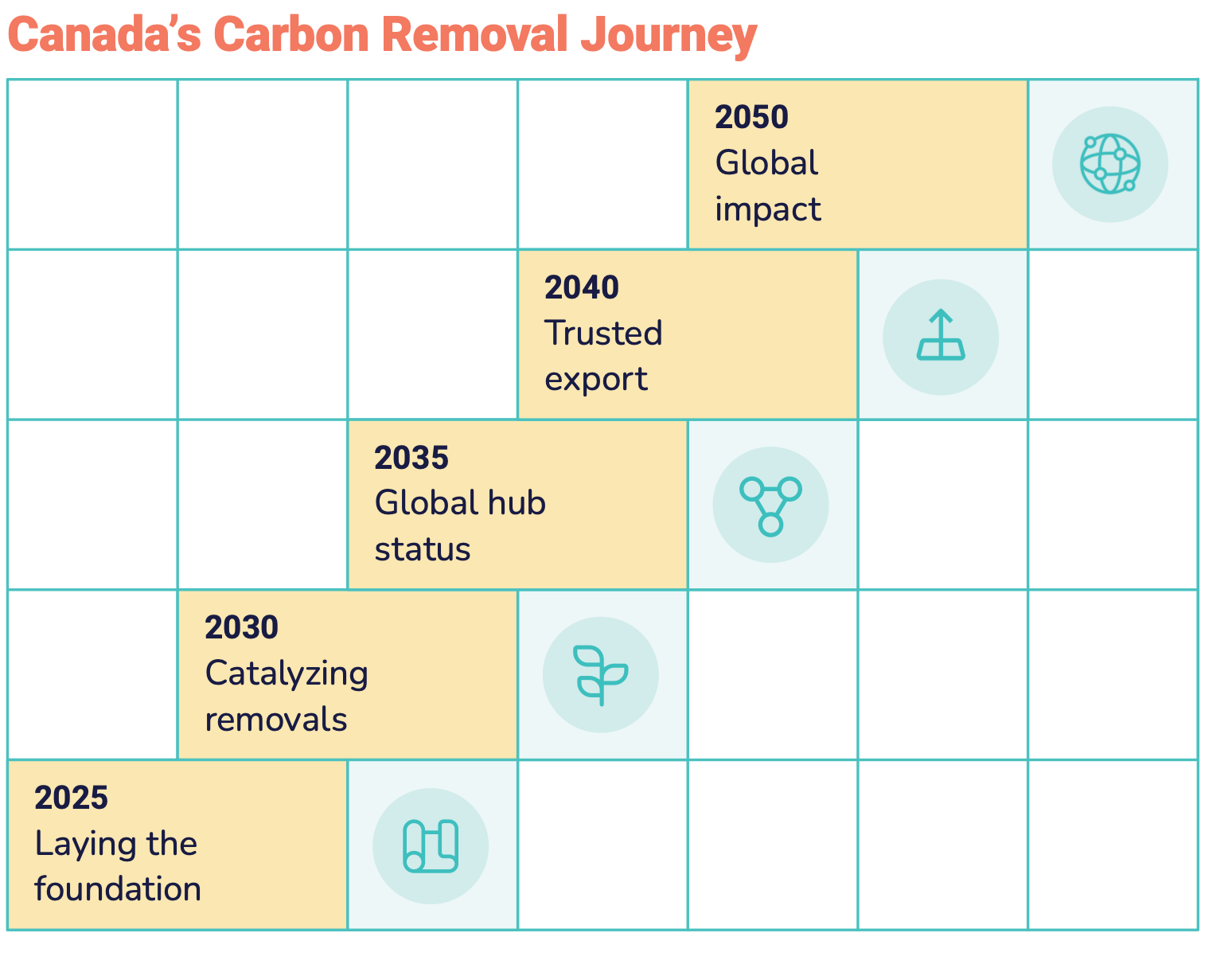
Source: Carbon Removal Canada’s recently released Billion Tonne Blueprint
2. To get to gigatonne-scale, Canada is focusing most heavily across three sectors of the economy: oil and gas, heavy manufacturing and mining, and coastal economic development
Oil and gas regions embrace direct air capture as a low-carbon transition strategy. The government of Alberta, representing Canada’s leading oil and gas producing province, sent a significant delegation to Ottawa for Carbon Removal Day. Alberta has attracted removals companies like Deep Sky and Climeworks, in large part by offering direct air capture companies a 12% investment tax credit that, when added to the national 60% investment tax credit, defrays a significant amount of the capital costs associated with building direct air capture projects.
Alberta has also supported the buildout of CO2 transportation and storage infrastructure, and has a workforce from the legacy oil and gas industry with the engineering and construction knowledge needed to support direct air capture. Officials from Alberta talked about how direct air capture is a strategic investment for their economy to decarbonize oil and gas production (and thus compete in international low-carbon fuels and products markets of the future), and then transform the economy from an extractive one to a removal-focused exporter of the future.
Manufacturing and mining companies see potential in enhanced rock weathering. The conference in Ottawa featured discussions from leaders in energy-intensive sectors like steel production, who have begun to explore how they can utilize their waste products to capture carbon. Karbonetiq and Algoma Steel participated on a panel where they discussed the potential for steel slag to help “inset” remaining emissions after large plant electrification upgrades. And they also talked about their work exploring the potential for steel slag to supply carbon removal credits to others working towards their net-zero goals.
On the mining side, leaders from historical mining communities, like the Thetford Mines in Quebec, talked about the massive carbon removal potential that legacy mine tailings could provide, while helping to remediate environmental liabilities and offer new economic opportunities in a region that has struggled to find its way over the past decades.
Coastal communities pioneer marine carbon removal businesses. A few marine carbon removal leaders, like Planetary, have projects operational in Canada. Policymakers from regions like Nova Scotia that are host to marine carbon removal pilots are leading the way to chart a regulatory course that enables project developers to build commercial projects, researchers to understand the full range of carbon and ecosystem impacts, and regulators to design appropriate policies that balance innovation and environmental protection.
3. Carbon removal purchasing marches forward in Canada
The Canadian government and the private sector are continuing to advance programs for purchasing carbon removal credits. Canadian public investment in direct purchasing may be limited to the $10Ms scale today, but government purchases are sending a strong signal to businesses to increase their voluntary purchasing in parallel. For one, the simple fact that the government has announced that it will be purchasing removals credits to meet their net-zero goals helps businesses justify their own voluntary purchases. Additionally, the government is offering a valuable service to the private sector by helping businesses sort wheat from chaff when it comes to which carbon projects to select for purchasing credits. By signaling which projects are worthy of offtakes, governments are helping to crowd in more purchases towards the highest impact efforts (especially given how nascent carbon removal is as a field and how little experience most corporate sustainability teams have with finding and contracting high-quality credits from emerging carbon removal approaches.
Efforts like Advance Carbon Removal, a new public-private partnership formally announced at the conference in Ottawa, show how the government of Canada is collaborating with the private sector to drive more voluntary purchasing. The initiative included commitments of $100M in carbon removal purchasing across government and private companies, and including supportive remarks from the Minister of Environment, Climate Change, and Nature.

Ed Whittingham (Advance Carbon Removal Coalition) and Hon. Julie Dabrusin (Minister of Environment, Climate Change, and Nature)
4. Elected officials, policymakers, and civil servants at every level care about carbon removal.
Julie Dabrusin, Canada’s Minister for Environment and Climate Change kicked off the first Fireside Chat of the day; we were on a panel with Frank De Rosiers, Assistant Deputy Minister for Strategic Policy and Innovation; and Jean Barclay, the Mayor of Innisfail spoke about the town’s commitment to hosting carbon removal projects. It wasn’t a single agency or province interested in carbon removal.
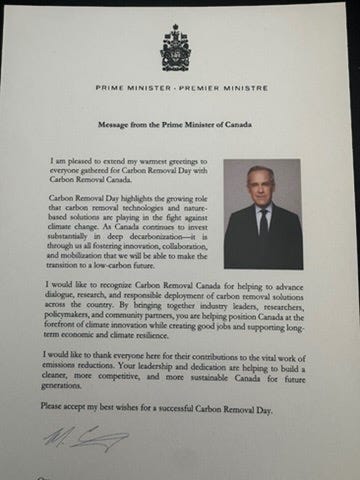
Even PM Carney shared a message of support, below. He might not have the political space to feature carbon removal as a top national priority at the moment, but it is encouraging to know there is support from the top on the policy framework that Canada is advancing to support removals innovation, commercialization, and standardization.
5. The Canadian carbon removal ecosystem is where the US ecosystem was a few years ago–can they learn from us?
There was a sense of optimism and community in the room at Carbon Removal Day that felt very reminiscent of where the US was in 2020. Carbon removal is still nascent, it’s growing but not crowded, and policy victories are modest but moving. In the US, we’ve started to see a contraction of the carbon removal policy, investment, and NGO space over the past year and uncertainty about major policy victories like the $3.5 billion DAC Hubs Program that marked the most significant, if unexpected, investment in carbon removal.
Canada isn’t the US, however, and their government operations allow for more consistency across political shifts–for example, while most of our Department of Energy staff changed between the Biden and Trump administrations, the vast majority of staff at Canadian agencies does not face that level of turnover with elections. Canadian colleagues on our panel were quick to remind us Yankees that some countries have (1) (relatively stable) carbon pricing, and (2) a lack of bitter partisanship that results in whipsaw policy from one administration to another. Hopefully this more consistent environment can lead to real commercial-scale projects in the near term, and durable policy frameworks that enable Canada to achieve its billion-tonne ambition.
 | A guest post by
|